
A Hall effect sensor is a small electronic component used inside many BLDC motors to detect the position of the rotor's magnetic field. This position data tells the motor controller exactly when to switch current to the next set of windings, which is what keeps a brushless motor spinning smoothly and in the right direction.
How Does a Hall Effect Sensor Work?
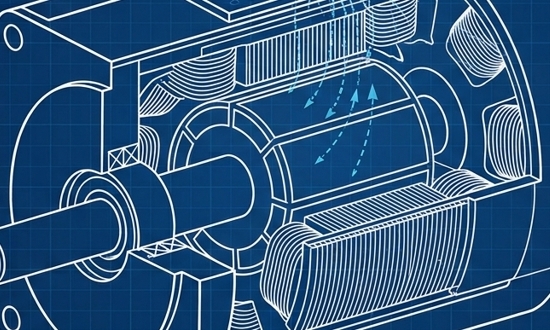
The sensor works based on the Hall effect—a principle where a voltage is generated across a conductor when it's exposed to a magnetic field perpendicular to the current flow. Inside a BLDC electric motor, small Hall effect sensors are typically mounted near the rotor, where they detect the changing magnetic poles as the rotor spins.
As the rotor rotates, the sensors output a signal pattern that changes based on which magnetic pole is nearby. The motor controller reads this signal and uses it to determine the rotor's exact position at any given moment, then energizes the correct motor windings in the right sequence—a process known as commutation.
Why BLDC Motors Need Position Feedback
Unlike brushed DC motors, which use physical brushes and a commutator to handle switching automatically, BLDC motors have no mechanical contact between the rotating and stationary parts. This is part of what makes them more durable and efficient, but it also means the motor needs another way to know the rotor's position. Hall effect sensors are one common solution to this problem, providing real-time position feedback to the controller.
Sensored vs. Sensorless BLDC Motors
BLDC motors that use Hall effect sensors are often referred to as "sensored" motors. Some BLDC motors instead rely on sensorless control methods, which estimate rotor position by measuring back-EMF (electromotive force) generated by the motor itself, without a dedicated sensor.
Each approach has its own trade-offs:
- Sensored motors generally provide more reliable position detection at low speeds and during startup, which can be useful in applications requiring precise control from a standstill.
- Sensorless motors can reduce component count and wiring complexity, which may be advantageous in certain compact or cost-sensitive designs.
The right choice typically depends on the specific application, required control precision, and operating conditions.
Common Applications
Hall effect sensors are used across a wide range of BLDC electric motor applications, including robotics, electric vehicles, industrial automation, and home appliances—generally anywhere precise, real-time rotor position feedback helps improve motor control performance.
Frequently Asked Questions
Do all BLDC motors have Hall effect sensors?
No. Some BLDC motors are sensorless and use back-EMF sensing instead of Hall effect sensors to estimate rotor position.
How many Hall effect sensors does a typical BLDC motor use?
Many BLDC motors use three Hall effect sensors, spaced to detect the rotor's position across its electrical cycle, though this can vary by motor design.
Can a BLDC motor run if a Hall sensor fails?
This generally depends on the motor controller design. In many cases, a failed sensor can affect commutation accuracy and motor performance, so it's worth consulting the manufacturer or a qualified technician if you suspect a sensor issue.


