
BLDC motors are becoming increasingly popular in modern industrial applications, home appliances, automobiles, and smart devices. Compared to traditional brushed motors, brushless DC motors (BLDC motors) offer advantages such as high efficiency, long lifespan, low noise, and low maintenance costs. However, a crucial component for fully utilizing the performance of a BLDC motor is the BLDC motor controller. This article will provide a detailed introduction to the working principles, components, and applications of BLDC motor controllers.
A BLDC motor controller is an electronic device that connects the power supply to the BLDC electric motor. Its main function is to control the motor's current direction, magnitude, and switching frequency to achieve speed regulation, direction control, and ensure safe operation of the motor. Simply put, the BLDC motor controller is the brain and speed regulator of the motor, determining how fast, stable, and efficient the motor operates.
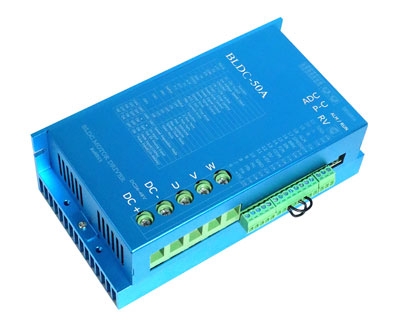
BLDC Motor Controller Components
A typical BLDC motor controller mainly consists of the following parts:
- Power Drive Module
The power drive module is mainly composed of power MOSFETs or IGBTs. It is responsible for converting the DC power supply into the three-phase AC power required by the motor, achieving motor rotor movement through rapid current switching.
The core of the power module is the control bridge (H-Bridge or three-phase inverter bridge), which determines which phase is energized and which phase is de-energized. - Microcontroller (MCU)
The microcontroller is the brain of the motor controller. Based on sensor feedback and control commands, it generates PWM (Pulse Width Modulation) signals to control the conduction and cutoff of the power module. Common MCUs include STM32, TI C2000, and NXP Kinetis. - Position Detection Sensor
BLDC motor controllers need to know the rotor position to correctly switch the current. Common position detection methods include:- Hall Sensor: Magnets are installed on the rotor, and the magnetic field change is detected by Hall elements.
- Rotary Encoder: High-resolution position feedback is achieved through a precision encoder.
- Sensorless Mode: The rotor position is determined by detecting the back EMF (Back Electromotive Force), suitable for low-cost and simple applications.
- Current and Voltage Detection Module
The controller needs to monitor the motor current and voltage in real time to achieve overcurrent protection, stall protection, speed control, and efficiency optimization. Common methods include shunt resistor current detection and voltage sampling circuits for detecting the supply voltage. - Communication Interface
High-end BLDC controllers usually support multiple communication interfaces, such as PWM signal input, analog voltage input, CAN bus, RS485, or Modbus, for receiving external control commands or interacting with other systems.
BLDC Motor Controller Working Principle
The core function of a BLDC motor controller is electronic commutation. The following details its working steps:
- Determining Rotor Position: The controller detects the rotor's magnetic pole position in real time using Hall sensors or sensorless methods, ensuring that current is supplied to the correct stator windings.
- Controlling Power MOSFET Conduction Sequence: BLDC motors typically have three phases (U, V, W). The controller selects two phases to be energized based on the rotor position, creating a rotating magnetic field that drives the rotor. The controller uses high-speed PWM to control the conduction time of the MOSFETs, thereby regulating motor speed and torque.
- Adjusting Motor Speed and Torque: The brushless DC motor controller adjusts the effective voltage by changing the PWM duty cycle, thus regulating the speed. Simultaneously, based on the load conditions, the controller can adjust the peak current to achieve torque control.
- Implementing Protection and Optimization: Advanced controllers can implement functions such as overcurrent protection, overvoltage protection, undervoltage protection, stall protection, and thermal protection, ensuring the motor operates under safe conditions. Furthermore, by optimizing commutation and current control, motor efficiency can be improved, and noise and heat generation can be reduced.
BLDC Motor Control Modes
Based on the application scenario, BLDC controllers mainly have the following control modes:
| Control Mode | Feature |
| Square Wave Control (Six-Step or Trapezoidal) |
|
| Sinusoidal Control |
|
| Sensorless Control |
|
| Vector Control (FOC, Field-Oriented Control) |
|
Summary
The BLDC motor controller is the core of the BLDC motor system. Through electronic commutation and precise control, the motor operates efficiently, smoothly, and safely. From basic square-wave control to advanced vector control, different control methods are suitable for different application scenarios. Understanding the working principles of BLDC motor controllers is crucial for engineers to optimize motor system performance and improve equipment efficiency.
With the development of electrification and intelligent technologies, the application of brushless motors and their controllers is expected to become increasingly widespread. Mastering their control principles will not only help in selecting appropriate motor solutions but also provide greater value in design, maintenance, and debugging processes.


