
Brushless DC (BLDC) motors are employed in modern technologies to provide great efficiency, a long lifespan, and precise control. From tiny drone motors to massive electric car motors, BLDC electric motors come in a variety of sizes and specs. Understanding the distinctions between small and large BLDC motors is critical when choosing the appropriate motor and controller for your project.
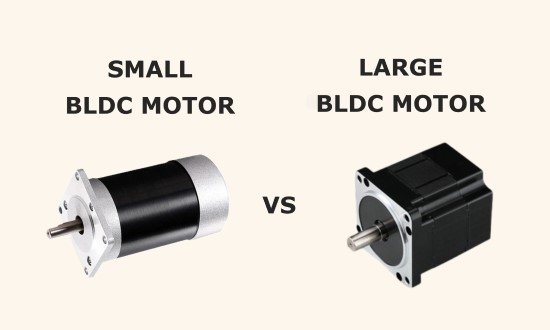
1. Power and Application Range
| Type | Power Range | Typical Applications |
| Small BLDC Motor | 1W–100W | Mini fans, micro drone motors, 3D printers, household appliances |
| Large BLDC Motor | 200W–tens of kW | Electric vehicles, electric scooters, industrial robots, high-thrust drones |
- Small motors are lightweight and compact, making them perfect for precision control and portability.
- Large motors handle higher currents and mechanical loads, necessitating stronger construction and better cooling.
2. Electrical Characteristics Comparison
| Feature | Small BLDC Motor | Large BLDC Motor |
| Voltage | 3–24V | 48–400V |
| Current | Hundreds of mA to a few A | Several A to tens of A |
| Starting Torque | Low | High, often requiring peak current at startup |
| Speed Range | High RPM (thousands to tens of thousands) | Medium to low RPM (hundreds to a few thousand), often paired with gear reduction |
- Smaller motors are less susceptible to power changes and easier to operate.
- Large motors necessitate sophisticated control strategies and protective features such as overcurrent and overheating protection.
3. Controller and Driver Differences
| Feature | Small BLDC Motor | Large BLDC Motor |
| Driving Method | Low-voltage PWM control, often integrated driver | High-current drive, sometimes separate driver module plus controller |
| Sensors | Hall sensors or sensorless FOC | Hall sensors or encoders for precise position control |
| Cooling | Small heat sinks suffice | Forced air or liquid cooling; driver thermal management is critical |
- Small controllers frequently employ a microcontroller with an integrated MOSFET driver, whereas large controllers require separate power boards, multi-channel MOSFETs, complicated algorithms (FOC, closed-loop speed control), and communication interfaces.
4. Mechanical Design and Thermal Management
- Small motors: compact, lightweight, low heat generation, generally sufficient with natural cooling.
- Large motors: high power output generates significant heat, requiring metal housings, heat sinks, or liquid cooling. Bearings, gears, and shafts must withstand heavy loads.
5. How to Choose Between Small and Large BLDC Motors
When selecting a Brushless DC motor, consider the following key factors:
- Application Requirements
- DIY projects or micro drones → small BLDC motor;
- Electric vehicles or industrial automation → large BLDC motor.
- Controller Capability
- Small motors → integrated driver modules are usually enough;
- Large motors → specialized BLDC controllers with overcurrent protection and closed-loop control are needed.
- Cooling and Longevity
- Large motors → proper cooling design is crucial for performance and lifespan;
- Small motors → low heat, but continuous high-speed operation still requires adequate ventilation.
Conclusion
Small and large BLDC electric motors differ greatly in terms of power, electrical properties, control systems, and mechanical design. Small motors are typically lightweight, precise, and simple to regulate, making them suitable for compact, low-power applications like drones, mini fans, and 3D printers. Large motors, on the other hand, generate more heat, produce more power, and necessitate more complex control systems, making them ideal for electric vehicles, industrial robots, and heavy-duty machinery. Choosing the appropriate brushless motor for your project is crucial to achieving peak performance, efficiency, and lifetime. Proper selection also guarantees that the controller and driver can withstand the needed electrical load while operating safely in all conditions.


