
When it comes to modern electric motors, two popular choices often come up: the Brushless DC (BLDC) Motor and the Alternating Current (AC) Motor. Both are widely used in various applications, from household appliances to industrial machinery, but they differ significantly in design, performance, and efficiency. In this blog, we will delve into the key differences between BLDC motors and AC motors, helping you understand the unique advantages of brushless DC motors.
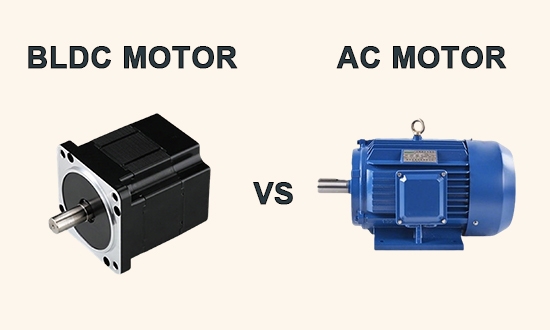
What is a BLDC Motor?
A BLDC motor, or Brushless DC Motor, operates without the use of brushes, which are common in traditional brushed DC motors. Instead, it uses electronic controllers to switch the current in the motor windings. This design allows for more efficient performance and fewer mechanical components. BLDC electric motors are known for their high efficiency, longer lifespan, and reduced maintenance compared to brushed motors.
What is an AC Motor?
An AC motor is a type of electric motor that runs on alternating current. AC motors can be classified into two primary types: Synchronous AC Motors and Induction AC Motors. AC motors rely on the alternating current to create a rotating magnetic field, which induces motion in the motor’s rotor. AC motors have been the standard for most industrial and household applications due to their simplicity, reliability, and low cost.
Key Differences between BLDC Motors and AC Motors
| Differences | BLDC Motors | AC Motors |
| 1. Motor Construction and Design | Brushless DC motors use permanent magnets on the rotor and windings on the stator, with an electronic controller to switch the current and drive motion. | AC motors use alternating current to generate a rotating magnetic field in the stator, which induces rotation in the rotor. |
| 2. Efficiency and Power Consumption | BLDC electric motors are more efficient due to the absence of brushes, leading to lower power loss and heat generation. | AC motors generally have more energy losses, especially in induction motors, but modern synchronous types can offer high efficiency. |
| 3. Maintenance and Durability | BLDC motors require minimal maintenance because there are no brushes to wear out, resulting in longer lifespans. | AC motors may need more maintenance, especially brushed models, due to brush wear and other mechanical components. |
| 4. Control and Speed Regulation | BLDC motors offer precise speed and torque control with electronic controllers, making them ideal for high-precision applications. | AC motors typically require additional equipment like variable frequency drives (VFDs) for speed control. |
| 5. Size and Weight | BLDC electric motors are smaller and lighter, making them suitable for space-constrained applications like electric vehicles and drones. | AC motors are usually larger and heavier, especially in higher power ratings. |
| 6. Cost | BLDC motors have a higher upfront cost due to more complex construction and control systems. | AC motors are generally less expensive and widely used in cost-sensitive applications. |
| 7. Applications | Brushless DC motors are ideal for applications requiring efficiency and precision, such as robotics, electric vehicles, and drones. | AC motors are more common in industrial equipment, household appliances, and large machines. |
Conclusion
When selecting between a BLDC motor and an AC motor, it's essential to consider the specific requirements of your application. Brushless DC motors excel in terms of efficiency, precision, and longevity, making them ideal for high-performance applications where space, weight, and control are critical. On the other hand, AC motors are well-suited for general-purpose, cost-effective solutions and have a proven track record in industrial and household appliances.
Ultimately, the choice between BLDC and AC motors will depend on your needs for efficiency, control, cost, and maintenance. As technology advances, both motor types continue to evolve, offering enhanced performance and broader applications.


