
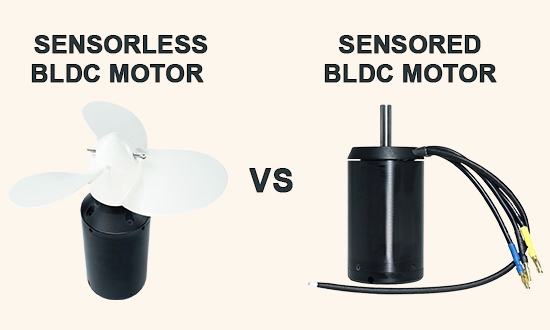
In modern motor technology, brushless DC motors are widely used due to their high efficiency, low maintenance, and long lifespan. They are commonly found in applications ranging from home appliances to power tools, robotics, and electric vehicles. BLDC motors can be classified into two main types: sensored BLDC motors and sensorless BLDC motors. While both types are BLDC electric motors, there are significant differences in their working principles, control methods, and applications.
Operating Principle
| Sensored BLDC Motor | Sensorless BLDC Motor |
| A sensored BLDC motor incorporates position sensors (typically Hall effect sensors) that constantly monitor the rotor’s position. These sensors send real-time feedback to the motor controller, allowing precise commutation of the motor. With this feedback control, the motor operates smoothly during startup and at low speeds, ensuring stable performance. The controller can directly use the sensor data to switch the motor phases at the right time for optimal efficiency and smoothness. | A sensorless BLDC motor, as the name suggests, does not use any position sensors. Instead, the motor controller estimates the rotor's position based on the back electromotive force (back EMF) generated by the motor’s rotation. This method does not rely on real-time sensor feedback and instead calculates the rotor position indirectly by measuring voltage and current changes. However, controlling a sensorless motor is more complex and relies on sophisticated algorithms. |
Startup and Low-Speed Performance
| Sensored BLDC Motor | Sensorless BLDC Motor |
| Sensored BLDC motors offer better startup performance and stability. Since the position sensors provide real-time rotor position feedback, the controller can easily determine the rotor’s position at startup and ensure smooth and precise operation. At low speeds, the motor runs steadily and with high control accuracy, making it ideal for applications that require fine motor control. | Sensorless BLDC motors can have more difficulty during startup and at low speeds. Since they do not have direct position feedback, the motor controller has to estimate the rotor’s position using the back EMF, which is weaker at low speeds. As a result, the motor may experience startup difficulties or unstable behavior at lower speeds. This can make sensorless motors less suitable for precise low-speed applications. |
Cost and Complexity
| Sensored BLDC Motor | Sensorless BLDC Motor |
| Because a sensored BLDC motor requires additional components like Hall sensors or other position sensors, the design is more complex and the cost is higher. Installation and tuning can also require more time and effort, which makes these motors better suited for applications where control precision and performance are critical. | Sensorless BLDC motors are simpler in design and do not require additional sensors, which makes them more cost-effective. They are also less prone to sensor failure, which enhances reliability. The simpler design also means less maintenance. However, they are typically used in applications where cost is more important than precise control. |
Efficiency and Performance
| Sensored BLDC Motor | Sensorless BLDC Motor |
| Sensored BLDC motors generally offer higher efficiency, especially during low-speed or high-load operations. The real-time rotor position feedback allows for precise commutation, minimizing power loss and ensuring stable performance. They are ideal for applications that require high efficiency and smooth operation, particularly at varying loads or speeds. | Sensorless BLDC motors tend to have lower efficiency at low speeds because of the lack of real-time position feedback. This can lead to power losses or less stable performance. However, when running at higher speeds, the controller can more accurately estimate rotor position using back EMF, and the motor can perform more efficiently in those conditions. |
Applications
| Sensored BLDC Motor | Sensorless BLDC Motor |
|
Sensored BLDC motors are commonly used in applications that require high precision and reliability, such as:
|
Sensorless BLDC motors are often found in cost-sensitive applications where high precision is not as critical, such as:
|
Fault Diagnosis and Maintenance
| Sensored BLDC Motor | Sensorless BLDC Motor |
| Diagnosing faults in a sensored BLDC motor is relatively straightforward. Since the sensors provide constant feedback on rotor position, issues like miscommutation or incorrect switching can be easily identified. However, the sensors themselves can fail over time, and if a sensor malfunctions, it may cause the entire motor system to fail. | Sensorless BLDC motors are typically more challenging to diagnose since they do not provide direct feedback. Fault detection may be more complex and requires analyzing other electrical parameters, such as voltage and current. On the positive side, since there are no sensors to fail, sensorless motors can be more reliable in terms of hardware durability. |
Conclusion
Both sensored and sensorless BLDC motors offer distinct advantages and disadvantages. The choice between the two largely depends on the specific application requirements. If you need high precision, stability, and efficiency—particularly at low speeds—sensored BLDC motors are a better choice. On the other hand, if cost is a key consideration and the application doesn't require precise control at all speeds, sensorless BLDC motors provide a simpler, more affordable solution.
Understanding the differences between these two types of motors helps you make an informed decision, ensuring you choose the right motor for your needs and get the best performance for your application.


