
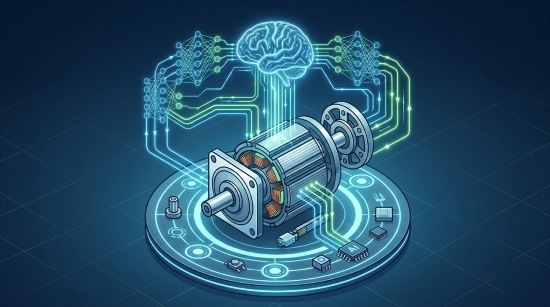
Artificial Intelligence is rapidly reshaping the way electric machines are designed and controlled. One of the most impactful areas of innovation is the brushless DC motor, which is widely used in electric vehicles, drones, robotics, and industrial automation. By integrating AI into motor control systems, engineers are improving efficiency, reliability, and adaptability beyond what traditional methods can achieve alone.
This article explores how AI enhances BLDC motor performance across four key areas: sensorless control, adaptive tuning, predictive maintenance, and energy efficiency.
AI-Enhanced Sensorless Control in BLDC Motors
A BLDC electric motor normally use electronic commutation rather than mechanical brushes, however it frequently relies on Hall effect sensors to determine rotor position. These sensors are more expensive, require more wiring, and may fail in severe situations like high temperatures or humidity.
Traditional sensorless techniques estimate rotor position using Back Electromotive Force (Back-EMF). However, at very low speeds, Back-EMF weakens or fails, making smooth starting and low-speed operation difficult.
AI addresses this shortcoming by adding data-driven estimating techniques:
- Machine learning models, such as neural networks, can estimate rotor position and speed using real-time current and voltage signals.
- These models learn complex nonlinear relationships that are difficult to capture with classical equations.
Impact: Improved low-speed performance, reduced dependency on physical sensors, and increased system reliability in compact or harsh environments.
Adaptive Control and Real-Time Parameter Tuning
Traditional BLDC motor control systems often use PID (Proportional-Integral-Derivative) controllers or Field-Oriented Control (FOC). While successful, these systems rely on set tuning parameters, which may not function optimum under changing situations.
In real-world applications, motor behaviour alters because:
- Load variation
- Temperature shifts
- Component aging
- External disturbances (e.g., wind or terrain)
AI enables adaptive control by continuously analyzing system feedback and adjusting control parameters in real time.
Rather than replacing PID controllers, AI typically enhances them by:
- Dynamically tuning control gains
- Adjusting torque and speed response
- Improving stability under nonlinear conditions
Impact: More stable torque output, improved responsiveness, and better efficiency across varying operating conditions such as drones in wind or EVs on inclines.
Predictive Maintenance and Fault Detection
Unexpected motor failure in industrial systems or electric cars can cause significant downtime and safety issues. Traditional maintenance solutions are frequently either time-based (preventive) or reactive (after a failure).
AI allows a shift toward predictive maintenance by evaluating real-time sensor data, such as:
- Vibration patterns
- Current signature analysis (CSA)
- Temperature trends
- Acoustic noise and harmonics
Machine learning models can detect subtle anomalies that indicate early-stage issues such as:
- Bearing wear
- Winding insulation degradation
- Rotor imbalance
Impact: Reduced downtime, lower maintenance costs, and extended motor lifespan through early fault detection and diagnosis.
Energy Efficiency Optimization with AI
Energy efficiency is crucial in applications with limited battery life, such as electric cars, drones, and robots.
Traditional control systems use predetermined efficiency maps or simpler models. However, these models do not adequately reflect real-time fluctuations in operational circumstances.
AI enhances energy efficiency by:
- Learning efficiency patterns from operational data
- Assisting in optimizing Field-Oriented Control (FOC) parameters
- Reducing unnecessary current losses and heat generation
In advanced systems, AI helps approximate optimal control strategies that adapt continuously to load and speed changes.
Impact: Lower energy consumption, reduced heat loss, and extended battery life in mobile and embedded systems.
The Rise of Edge AI in Motor Control Systems
Edge AI is a crucial trend driving AI adoption in BLDC systems, in which machine learning models operate directly on microcontrollers or motor control chips rather than on the cloud.
This technique provides:
- Ultra-low latency control
- Real-time decision-making
- Improved system security and reliability
- Independence from network connectivity
As embedded hardware becomes more powerful, AI-driven motor controllers are moving closer to fully autonomous optimization systems.
Conclusion
The incorporation of artificial intelligence into brushless DC motor systems is causing a significant shift in the way motors are controlled, monitored, and optimized. Instead of replacing existing control techniques, AI improves them, resulting in hybrid systems that are more adaptable, efficient, and intelligent.
From sensorless control to predictive maintenance and energy optimization, artificial intelligence is enabling the next generation of smart motor systems for electric cars, robotics, and industrial automation.


