
The KV rating of a brushless DC (BLDC) motor indicates its rotational speed (in RPM, or revolutions per minute) per volt of input voltage under no-load conditions. The KV rating is one of the most important parameters when selecting a BLDC motor, as it directly affects the motor's speed, torque, efficiency, and suitability for specific applications.
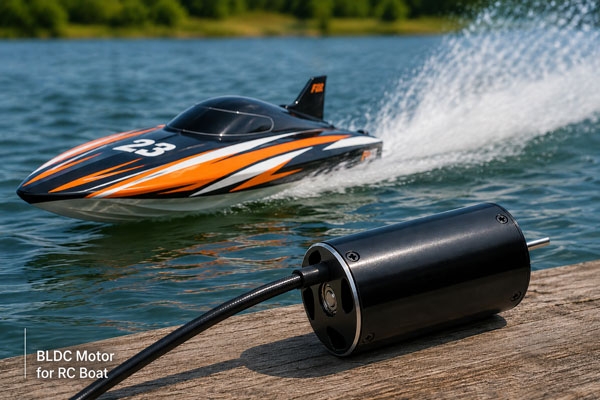
What Does KV Mean in a BLDC Motor?
Many beginners assume KV means "kilovolt," but in BLDC electric motors, it means:
RPM per Volt
Formula:
Motor Speed (RPM) = KV × Voltage (V)
Example:
| KV Rating | Voltage | Theoretical RPM |
| 800KV | 12V | 9,600 RPM |
| 1200KV | 12V | 14,400 RPM |
| 2000KV | 12V | 24,000 RPM |
Actual speed is usually lower due to load, friction, and efficiency losses.
Why is KV Rating Important?
The KV rating determines how a brushless DC motor behaves by indicating the number of revolutions per minute (RPM) it produces per volt applied without load. Higher KV motors offer greater speed, while lower KV motors generally deliver more torque, efficiency, and stability under load.
High KV BLDC Motors
| Characteristic | Typical applications | Example |
|
|
2200KV BLDC motor + 3S LiPo battery Produces very high RPM for fast acceleration. |
Low KV BLDC Motors
| Characteristic | Typical applications | Example |
|
|
750KV brushless DC motor + large propeller Produces a strong lifting force while consuming less power. |
Relationship Between KV and Torque
KV rating and torque are inversely related. A lower KV BLDC motor typically produces higher torque at lower speeds, making it suitable for heavy-load applications. In contrast, a higher KV BLDC motor delivers higher RPM but lower torque, making it ideal for high-speed applications such as racing drones and lightweight electric vehicles.
Generally:
- Higher KV → Higher RPM
- Lower KV → Higher Torque
Motor torque constant (Kt) is inversely proportional to KV: Kt ∝ 1 / KV
This means:
- 500KV → High Torque
- 1000KV → Medium Torque
- 2200KV → Lower Torque
How Voltage Affects Motor Speed
Motor speed is determined by both the KV rating and the supply voltage.
For example, a 1000KV BLDC motor running at 12V has a theoretical no-load speed of 12,000 RPM. If the voltage is increased to 24V, the speed rises to approximately 24,000 RPM. In real-world applications, the actual RPM is usually lower due to load, friction, motor efficiency, and controller limitations. Therefore, increasing voltage generally increases BLDC motor speed, but it should always remain within the motor's rated voltage to avoid overheating or damage.
How to Choose the Right KV Rating
For Drones
| Heavy Lift Drone | 300–900KV |
| Aerial Photography | 700–1200KV |
| FPV Racing Drone | 1800–2800KV |
For Electric Bikes
| Hill Climbing | Low KV |
| Commuting | Medium KV |
| High-Speed Riding | Higher KV |
For Industrial Equipment
Low KV BLDC motors are often preferred because they provide:
- Stable torque
- Better efficiency
- Lower operating temperatures
- Improved reliability
Frequently Asked Questions (FAQ)
Does a higher KV BLDC motor produce more power?
No. A higher KV BLDC motor does not automatically produce more power. KV only indicates how fast a motor spins per volt with no load. Power depends on voltage, current, efficiency, and motor design. High-KV motors favor speed, while low-KV motors generally provide greater torque for the same power input.
Is a lower KV BLDC motor more efficient?
A lower KV BLDC motor is not inherently more efficient. Efficiency depends on motor design, operating load, voltage, and speed. Lower KV motors typically deliver higher torque per amp and perform better in low-speed, high-torque applications, while higher KV motors are better suited for high-speed uses when properly matched to the application.
Can I increase RPM by increasing voltage?
Yes. Increasing the voltage increases a BLDC motor’s rpm because motor speed is proportional to voltage.
What is the best KV rating?
There is no single best KV rating. The ideal KV depends on your application, voltage, propeller size, and required torque. Lower KV suits high torque, while higher KV delivers higher speed with smaller propellers.
Conclusion
The KV rating of a BLDC motor indicates how many RPM it produces per volt under no-load conditions. A higher KV motor provides higher speed, while a lower KV motor delivers greater torque. Understanding KV helps engineers and hobbyists select the right BLDC motor for drones, electric vehicles, robotics, and industrial applications.


