
If you've been comparing BLDC motors for a project, whether it's a drone build, an RC car, or an industrial application, you've likely run into the terms "outrunner" and "inrunner." These describe two different rotor configurations, and the difference between them affects torque, speed, size, and which applications each one is best suited for. This guide breaks down what each type is, how they differ, and how to figure out which one fits your project.
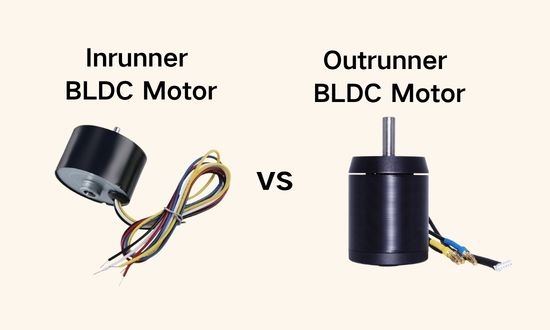
What Is an Inrunner BLDC Motor?
In an inrunner motor, the rotor, the rotating magnet assembly, sits inside the stator windings, similar to the layout of a traditional electric motor. The outer casing stays stationary while the inner shaft spins.
Because the rotor is smaller and lighter relative to the overall motor size, inrunner motors are generally capable of higher rotational speeds, though typically at lower torque compared to an outrunner of similar size and weight.
What Is an Outrunner BLDC Motor?
In an outrunner motor, the configuration is reversed—the rotor forms the outer shell of the motor and spins around a stationary inner stator. This design is common in drone motors and RC aircraft, where the outer casing itself is what rotates along with the propeller or load.
Because the magnets sit farther from the center (a larger radius), outrunner motors typically generate higher torque at lower speeds, often without needing a separate gearbox to reach usable torque levels.
How Does the Rotor Position Actually Affect Performance?
The physics behind this comes down to leverage. In an outrunner, the magnets are positioned at a greater distance from the rotational axis, which increases the torque produced for a given amount of current—similar to how a longer wrench handle makes it easier to turn a bolt. This is why outrunners tend to favor torque over raw speed.
Inrunners, by contrast, keep the rotating mass small and close to the center, which reduces rotational inertia and allows the brushless DC motor to spin up and change speed more quickly—favoring high RPM applications.
Key Differences at a Glance
| Factor | Inrunner | Outrunner |
| Rotor Position | Inside the stator | Outside the stator |
| Typical Speed | Higher RPM | Lower RPM |
| Typical Torque | Lower torque | Higher torque |
| Rotational Inertia | Lower (faster response) | Higher (slower response) |
| Common Use Cases | High-speed tools, RC cars, applications paired with a gearbox | Drones, RC aircraft, direct-drive applications |
| Size/Weight for Given Torque | Generally more compact | Often larger for equivalent torque |
| Gearbox Requirement | Often needed to increase usable torque | Frequently unnecessary |
Which Type Do Common Applications Use?
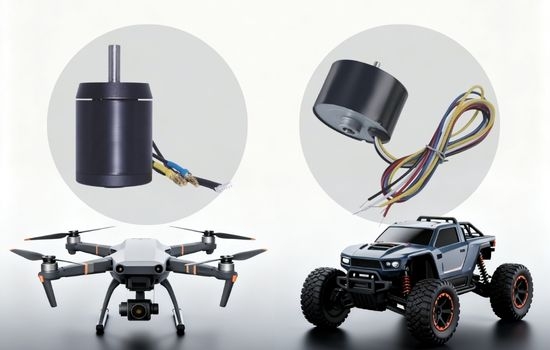
Drones and RC aircraft mostly use outrunner motors. Propellers need relatively high torque at moderate RPM rather than extremely high speed, so an outrunner's torque characteristics suit direct-drive propeller setups without adding a gearbox—which would add weight and complexity to a flying vehicle.
RC cars, especially high-speed racing setups, more commonly use inrunner motors. These applications benefit from an inrunner's higher RPM capability, typically paired with a gearbox or transmission system to convert that speed into usable torque at the wheels.
Which One Should You Choose for Your Application?
- If your application needs high speed and you're comfortable pairing it with a gearbox to achieve the torque you need, an inrunner is often the more practical choice.
- If your application needs higher torque without added gearing, such as direct-drive propulsion in drones or RC aircraft, an outrunner is typically the better fit.
- Consider your space and weight constraints too: outrunners are often bulkier for the torque they produce, while inrunners tend to be more compact but may require additional components (like a gearbox) to reach the torque your application needs.
- Think about response time: if your application involves frequent, rapid speed changes, an inrunner's lower rotational inertia may offer quicker responsiveness.
Frequently Asked Questions
Q1: Are outrunner motors more efficient than inrunner motors?
A1: Efficiency depends more on the specific motor's design, winding, and application match than on rotor configuration alone. Neither type is inherently more efficient—the right choice depends on matching the motor's torque and speed characteristics to your application.
Q2: Can an outrunner motor spin as fast as an inrunner?
A2: Generally, outrunners are less suited to very high RPM applications due to their larger rotating mass and higher rotational inertia, though specific models vary. If very high speed is the priority, an inrunner is typically the better starting point.
Q3: Do outrunner motors need a gearbox?
A3: Not usually. Outrunners are often used in direct-drive setups because they naturally produce more torque at lower speeds, which is why they're common in drone and RC aircraft propeller applications.
Q4: Which type is more common in industrial automation?
A4: Both types are used in industrial settings depending on the application—inrunners are common where high-speed operation paired with gear reduction is needed, while outrunners may be selected for applications requiring higher torque directly from the motor.
Final Thoughts
Neither design is inherently "better", they're built for different priorities. Inrunners lean toward speed and compactness, while outrunners lean toward torque and simplicity in direct-drive setups. The right choice depends on your specific application's speed, torque, and space requirements.
Need help figuring out which configuration fits your project? Explore our full range of BLDC motors at bldc.com.


