
Choosing the right operating voltage is an important step when designing a battery-powered system. Whether you are developing an electric vehicle, a mobile robot, an automated machine, or industrial equipment, a 24V or 48V brushless DC (BLDC) motor may be suitable for your application.
Both voltage options are widely used in electric drive systems, but they differ in current requirements, wiring, power system compatibility, and component selection.
So, which should you choose? This guide compares 24V and 48V BLDC motors, explains their advantages and limitations, and helps you select a voltage based on your power requirements, operating conditions, and budget.
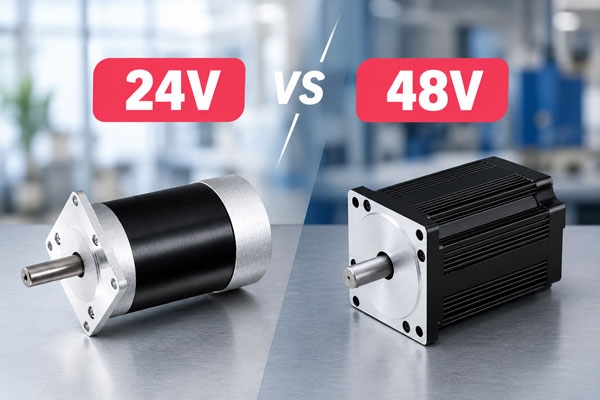
Core Differences: Voltage, Current, and Power
One key electrical difference between 24V and 48V BLDC motor systems is current demand. For the same electrical input power, a higher voltage requires less current.
Power = Voltage × Current
However, a BLDC motor's rated power and rated current are determined by its motor design and rated operating point. Rated current can vary with winding configuration, motor efficiency, rated speed, torque, and other operating characteristics.
Therefore, when selecting a BLDC motor, use the manufacturer's rated current and performance specifications rather than calculating rated current from rated power alone. In general, a 48V system requires less current than a 24V system at the same power level. This can help reduce wiring requirements and resistive losses, especially in higher-power applications.
24V vs. 48V BLDC Motor Comparison
| Feature | 24V BLDC Motor | 48V BLDC Motor |
| Current at the same electrical power | Higher | Approximately half |
| Wiring requirements | May require larger conductors at higher power | May allow smaller conductors at the same power |
| Resistive wiring losses |
Higher at the same current-path resistance and power |
Lower under equivalent conditions |
| Component compatibility | Suitable for existing 24V systems | Requires compatible 48V-rated components |
| System cost | Can be lower when 24V components are readily available | Depends on battery, controller, and protection requirements |
| Typical applications | Small robots, industrial equipment, and low-voltage systems | Higher-power mobile equipment, electric vehicles, and battery-powered drives |
Neither voltage is universally better. The right choice depends on the required power, available power supply, motor speed and torque requirements, and the design of the complete drive system.
Advantages of 48V BLDC Motors
A 48V BLDC motor system can be advantageous when an application requires substantial power from a battery-powered source.
Lower Current at the Same Power
For the same electrical input power, a 48V system generally requires less current than a 24V system. Lower current can help reduce wiring requirements, connector ratings, and resistive losses.
However, a BLDC motor's rated current should not be calculated simply by dividing rated power by voltage. Rated current depends on the motor's efficiency, winding design, speed, torque, and rated operating conditions.
For example, our 1000W BLDC motor is rated at 52.08A at 24V, 34.72A at 36V, and 26.04A at 48V.
Reduced Wiring Losses and Heat
Higher current causes more heat and energy loss in wires and other electrical components. At the same power level, a 48V system requires less current than a 24V system, reducing resistive losses and heat in the wiring.
This can be especially useful for higher-power BLDC motor applications where current demand is higher.
Practical for Higher-Power Battery Systems
A 48V architecture is commonly considered for electric mobility and mobile equipment that require several hundred watts or more.
Potential applications include:
- Electric bikes and light electric vehicles
- Delivery robots and autonomous mobile robots (AMRs)
- Battery-powered utility equipment
- Mobile material-handling systems
- Industrial actuators and drive mechanisms
The suitability of a 48V BLDC motor still depends on the required continuous and peak power, torque, speed, and duty cycle.
When Should You Choose a 24V BLDC Motor?
A 24V BLDC motor can be a practical choice when the application prioritizes compatibility, straightforward integration, or the availability of existing power components.
Low- to Moderate-Power Applications
For applications with modest power requirements, 24V systems may offer a convenient balance between performance and cost.
Examples include:
- Small mobile robots and robotic platforms
- Compact automation equipment
- Battery-powered instruments and mechanisms
- Conveyor and material-handling systems
- Equipment designed around an existing 24V DC supply
Integration with Existing 24V Equipment
Many industrial control systems and automation installations use a 24V DC power supply for sensors, relays, and control circuits. If the motor controller is also designed to operate from 24V, choosing a compatible BLDC motor and controller may simplify system integration and avoid the need for an additional power conversion stage.
Check the motor controller's supply voltage range and the battery or power supply's minimum and maximum operating voltages before making a selection.
Applications Where 24V Meets the Power Requirements
A 24V system can also support higher-power BLDC motors when the motor, controller, battery, wiring, connectors, and protection devices are properly rated.
For example, a 750W BLDC motor running at 24V requires more current than a comparable 48V system. This higher current should be considered when selecting the battery, controller, wiring, and other electrical components.
Therefore, 24V can still be a practical choice for applications requiring several hundred watts or more.
How to Choose Between a 24V and 48V BLDC Motor?
Before selecting a motor, evaluate the following factors.
- Required Power and Current
Determine the brushless motor's rated power and peak power requirements. Estimate the current at the intended operating voltage and confirm that the battery, controller, wiring, and connectors can support both continuous and peak demand. Remember that mechanical output power and electrical input power are not identical because the motor and controller have losses. - Rated Speed and Torque
Voltage alone does not determine whether a BLDC motor can deliver the required torque. Review the BLDC motor's rated speed, torque-speed curve, winding configuration, and motor controller settings. If the application requires high torque at low speed, a suitable gearbox may be necessary. For geared applications, consider the gearbox ratio, output torque, output speed, and transmission efficiency alongside the motor specifications. - Battery and Controller Compatibility
The motor, controller, and power supply must operate within compatible voltage ranges. For battery-powered systems, consider the fully charged battery voltage as well as its nominal voltage. A nominal 48V battery, for example, may exceed 48V when fully charged. The controller's maximum voltage rating must accommodate the actual supply voltage and relevant transients. - Operating Environment and Duty Cycle
Continuous operation, frequent starts and stops, sudden load changes, and limited ventilation can affect BLDC motor temperature and service life. Check the brushless DC motor's continuous and peak ratings, cooling conditions, enclosure protection, and expected operating cycle before finalizing the design. - Total System Cost
Compare the cost of the complete drive system, including the BLDC motor, controller, battery, charger, cables, connectors, and protection components. A 24V system may be more economical when compatible components are already available. A 48V system may reduce current-related wiring requirements at higher power. Neither option guarantees a lower total cost in every application.
Frequently Asked Questions
Q1: Can I run a 48V BLDC motor on a 24V power supply?
A1: It depends on the BLDC motor and controller specifications. A brushless motor designed for 48V may run at a lower speed when supplied with 24V, but its achievable speed, torque, and power depend on the motor's electrical characteristics and the controller's operating limits. Some motor controllers may not start or operate correctly below their minimum input voltage. Check the manufacturer's voltage range and performance data before testing a lower-voltage supply.
Q2: Is a 48V BLDC motor more efficient than a 24V motor?
A2: Not necessarily. At the same electrical power and equivalent resistance in the current path, a 48V system draws approximately half the current and experiences about one-quarter of the resistive wiring losses.
However, overall efficiency depends on the motor design, winding resistance, controller, operating speed, mechanical load, and other system losses. A direct comparison requires performance data under equivalent operating conditions.
Q3: Do I need a different controller for a 24V and 48V BLDC motor?
A3: The controller must support the brushless motor's intended supply voltage and electrical requirements. Some motor controllers support a broad voltage range, while others are designed for a specific voltage class.
Check the controller's input voltage range, maximum voltage, continuous current, peak current, and compatibility with the motor's feedback and control requirements. Never connect a 48V supply to a controller that is rated only for 24V.
Conclusion
The right choice depends on your application requirements. Choose 24V for existing 24V systems and moderate power applications. Consider 48V for higher-power applications where lower current can benefit wiring and power distribution. In either case, check the motor's rated power, torque, speed, and controller compatibility.
At BLDC.com, you can explore BLDC motor options for different voltage and power requirements. Matching the brushless motor to your application and operating conditions is the first step toward developing a reliable drive system.


